
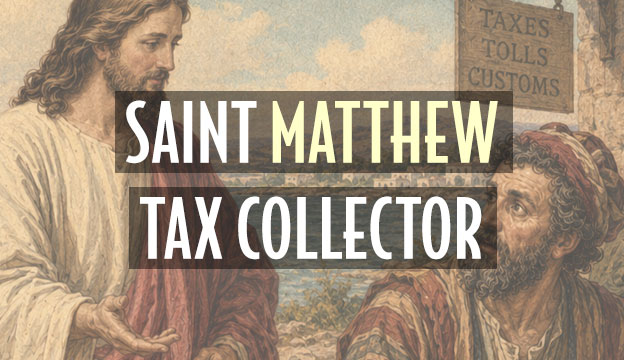
Have you ever felt like your past defines you, or that you’re without purpose or significance? If so, you’ll appreciate the story of St. Matthew.
Matthew the Apostle was a tax collector before becoming one of Jesus Christ’s twelve disciples, and ultimately cannonized as a saint. In fact, his unlikely journey from collecting taxes to preaching the Gospel is one of the most memorable redemption stories in the New Testament, and it’s a powerful reminder that where you start doesn’t have to be where you end up.
Matthew’s connection to taxes is more than an interesting detail from his past. It helps explain why his calling was so surprising, and why his story became such a powerful example of forgiveness, mercy, and personal transformation.
Matthew, the Despised Tax Collector
According to the Bible, Matthew worked in or near Capernaum, an important fishing and trading center beside the Sea of Galilee. Rather than preparing annual income tax returns, he likely collected customs duties or tolls on merchandise moving through the region. Christian tradition holds that he collected revenue under the government of Herod Antipas, the ruler of Galilee at the time.
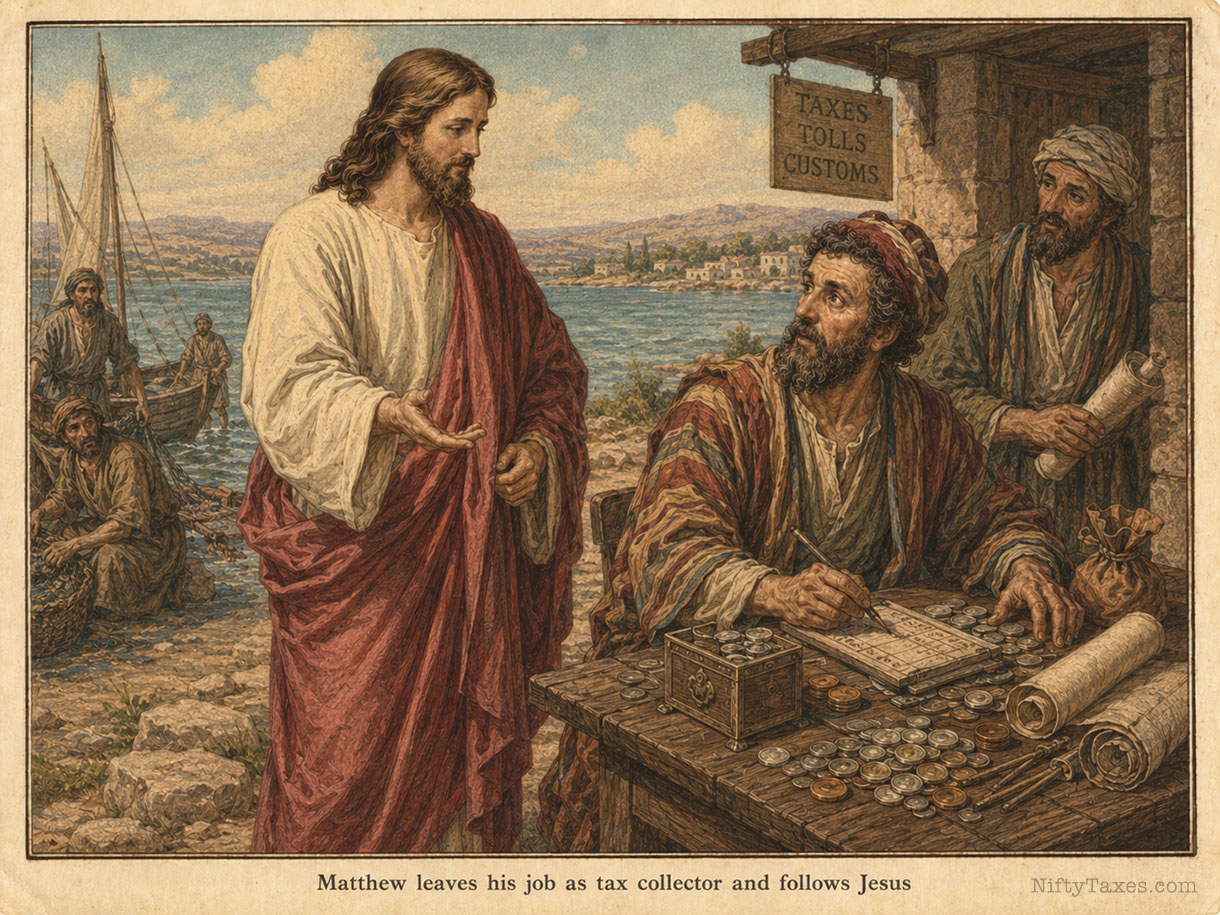
The Gospel of Matthew introduces him in Matthew 9:9 while he is sitting at a tax collection booth likely collecting tolls on merchandise when Jesus walked by.
“As Jesus passed on from there, he saw a man named Matthew sitting at the customs post. He said to him, ‘Follow me.’ And he got up and followed him.”
The invitation is remarkably simple. Jesus tells Matthew to follow him, and Matthew apparently leaves his old occupation behind without hesitation.
Can you imagine that kind of radical certainty? He traded his government job for a life of wandering and preaching. It was at this point that many believe he took the Christian name Matthew, which beautifully translates to “Yahweh’s gift.”
In modern times, this would be like leaving your steady job at the IRS to join the Buddhist monks walk for peace. It also reminds me of when Dorothy Boyd resigned from her accounting job at Sports Management International to help Jerry Maguire start his new, idealistic agency!
Why Were Tax Collectors So Hated in the Bible?
Tax collectors never been popular figures in history, but in first-century Israel, the animosity toward them was pretty intense. Because they worked for the occupying Roman authorities and local rulers like Herod Antipas, Jewish tax collectors were viewed as traitors and sinful collaborators by their own people.
Rome and its local rulers demanded numerous taxes, tolls, and customs fees, and the people responsible for collecting them were symbols of an unpopular political system.
The tax collection process itself also had a reputation for corruption. Tax collectors or their contractors could demand more than the government required and pocket the difference. This created a sharp divide between the wealth of these “publicans” and the average citizens who were barely scraping by.
Although the Bible does not specifically accuse Matthew of cheating anyone, his occupation alone would have made him a social and religious outcast. That helps explain why religious leaders were disturbed when Jesus later ate with Matthew and other tax collectors. In Matthew 9:11 they asked Jesus’ disciples:
“Why does your teacher eat with tax collectors and sinners?”
Jesus replied that healthy people do not need a physician, but sick people do, adding that he had come to call sinners rather than the self-righteous.
For Jesus, Matthew’s profession did not make him unreachable. In fact, it was quite the opposite. His tedious job and spiritual brokenness would be the key to his salvation.
Matthew: From Tax Collector to Apostle
After leaving his tax booth, Matthew became one of the Twelve Apostles. The contrast would have been striking: a man who once collected tax revenue for the authorities was now traveling with a teacher who preached mercy, generosity, and concern for the poor.
Matthew’s experience as tax collector probably made him well qualified for his new role as an Apostle, which required keeping careful records. His former job would likely have required literacy, arithmetic, organization, and familiarity with different languages or currencies. That connection is interesting because Christian tradition identifies him as the author of the Gospel of Matthew.
The book itself does not name its author, and modern biblical scholars debate whether the apostle personally wrote the Gospel in the exact form we have today. Nevertheless, the early Church strongly associated the Gospel with Matthew, and he has long been honored as both an apostle and an evangelist.
Saint Matthew, Patron Saint of Accountants
After Jesus’ resurrection, Matthew didn’t just stay in Judea. He took his message on the road! While historical records are a bit thin, tradition says he traveled to places like Ethiopia (near the Caspian Sea), Persia, Macedonia, and Syria. He is believed to have established Christian communities in both Ethiopia and Persia before eventually dying as a martyr for his faith.
Because of his earlier profession, Saint Matthew became the patron saint of tax collectors. He is also commonly associated with accountants, bookkeepers, bankers, financial professionals, and customs officers.
His feast day is celebrated on September 21 in the Roman Catholic Church and various Western Christian traditions.
Matthew is probably the most important biblical figure connected directly to taxes, although he was certainly not the only one. Taxes appear numerous times throughout the Bible, from Roman tribute payments to the famous question about giving to Caesar what belongs to Caesar.
Saint Matthew’s Prayer for Financial Help
Do you need a little help with your own finances, debts, or taxes? Many people turn to St. Matthew in prayer for help with money troubles, relief from debt, or guidance in managing their finances wisely. Here is St. Matthew’s prayer for financial help:
“O Saint Matthew, faithful servant of Christ, I turn to you for intercession regarding my financial needs. Please help me find relief from debt and grant me the wisdom to manage my resources wisely. I ask for your guidance in seeking prosperity to better serve God and my neighbor. Amen”
So, what does the story of Saint Matthew mean in out time?
What Saint Matthew’s Story Means
Matthew’s tax career is important because it shows just how unexpected Jesus’ choice of disciples could be. Jesus did not select only religious scholars, respected community leaders, or people with spotless reputations. His followers included fishermen, political opposites, doubters, and one unpopular tax collector.
Matthew’s story is ultimately not about taxes or accounting. It is about the possibility of change.
A man who once sat at a revenue booth collecting money became an apostle who helped spread one of history’s most influential religious messages. For Christians, Matthew’s story is a beacon of hope, and his life remains a reminder that a person’s occupation, reputation, or past mistakes don’t define our future potential.
Saint Matthew Tax FAQs
Yes. Matthew 9:9 describes Matthew sitting at a tax or customs booth when Jesus called him to become a disciple.
Matthew probably collected customs duties, transportation tolls, or taxes on goods moving through Capernaum and the surrounding region rather than modern income taxes.
They were associated with unpopular rulers and had a reputation for overcharging people. Their work could therefore be viewed as both politically disloyal and financially dishonest.
Christian tradition generally identifies the tax collector Levi in Mark and Luke with Matthew the Apostle. The similar calling stories strongly support that interpretation, although the Bible does not explicitly describe a name change.
Yes. Saint Matthew is traditionally recognized as the patron saint of tax collectors, accountants (CPAs), bookkeepers, bankers, and certain other financial professionals.
Saint Matthew was not formally canonized because he lived and died in the first century, long before the modern canonization process existed.
If you have thoughts on Saint Matthew and taxes, drop us a comment below. Thanks for visiting Nifty Taxes!