If you’re a Christian staring at a pile of tax forms with hatred in your heart, you might ask yourself, “What would Jesus do?” Hmmm… that’s actually an interesting question!
Did Jesus pay taxes?
The short answer is: Yes. Taxes are mentioned numerous times in the Bible, as Jesus’ world was shaped by both Jewish religious obligations and Roman political rule. Tax collectors also appear often in the Gospels, and were widely disliked because they worked within the Roman taxation system, and often collected more than was owed.
Anyway, the stories involving Jesus and taxes are pretty interesting, and like usual, he usually gets the last word. Here are the two most famous Bible stories involving Jesus and taxes, invoving a dangerous verbal trap and a miraculous fish.
“Render Unto Caesar”
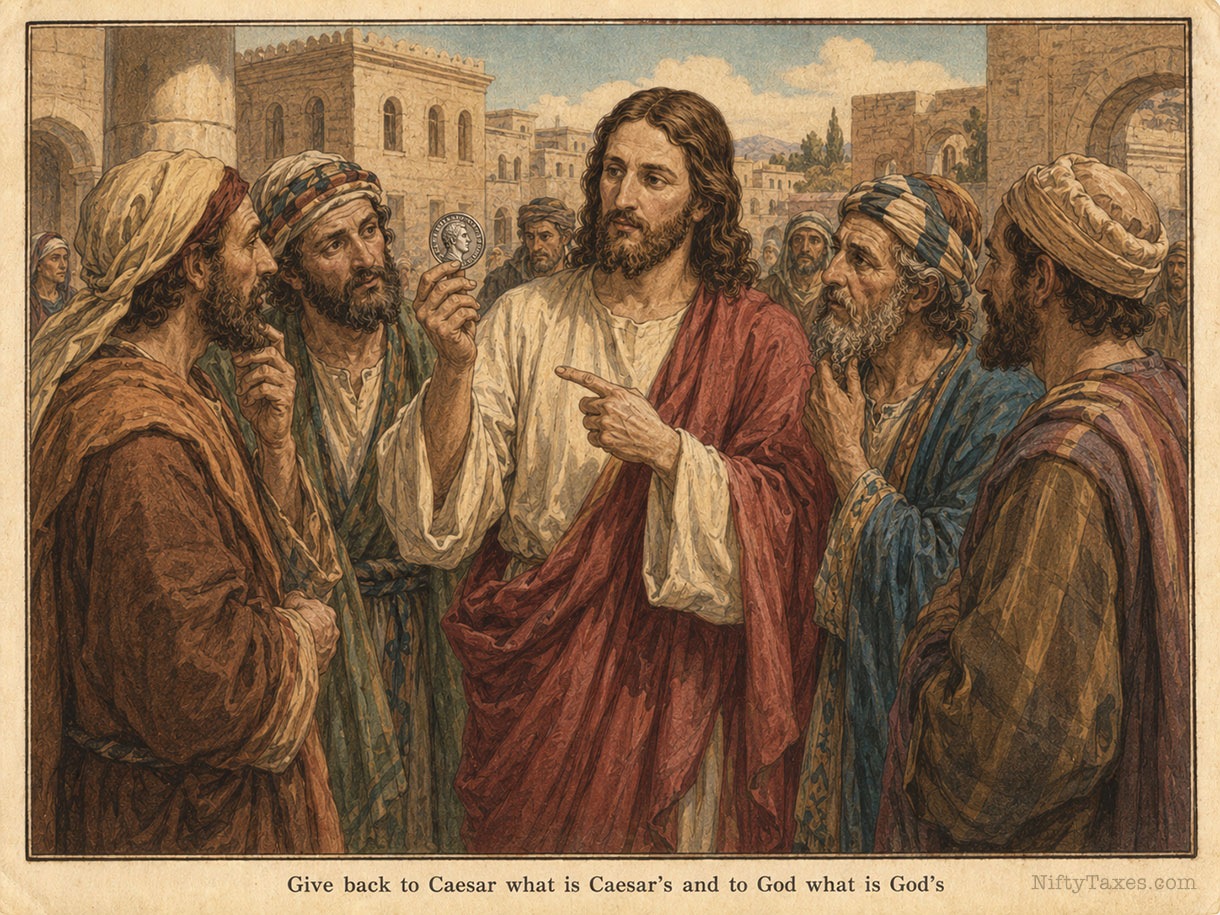
If you’ve ever heard the phrase “Render unto Caesar,” you’ve heard Jesus’ most famous commentary on taxation from Matthew 22:15-22.
Here’s the scene: A group of critics (the Pharisees and Herodians) tried to corner Jesus with a political landmine: “Is it right to pay the imperial tax to Caesar or not?”
It was an obvious trap. If Jesus said “yes,” he would anger the locals who hated Roman occupation. If he said “no,” the Romans could arrest him for tax evasion or encouraging rebellion against Rome.
Fact: Citizens who did not pay taxes during Caesar’s time faced harsh penalties of property seizure, debt slavery, and imprisonment.
Jesus, ever the master of the mic-drop, asked to see the coin used for the tax, which was a Roman denarius. He pointed to the face on the coin and asked, “Whose image is this?”
When they said “Caesar’s,” he delivered the legendary line, “Give back to Caesar what is Caesar’s and to God what is God’s”.
The secret meaning of this quote from Jesus wasn’t just about money. The coin had Caesar’s image on it, but the Bible teaches us not to worship false idols. Essentially, Jesus was saying: “Give Caesar your money, but give your whole self to God”.
In other words, being a citizen of a nation means contributing financially toward the services and benefits it provides. Being a citizen of the Kingdom of Heaven, however, calls for our highest loyalty, obedience, and commitment to God.
The Miracle of the Coin in the Fish’s Mouth
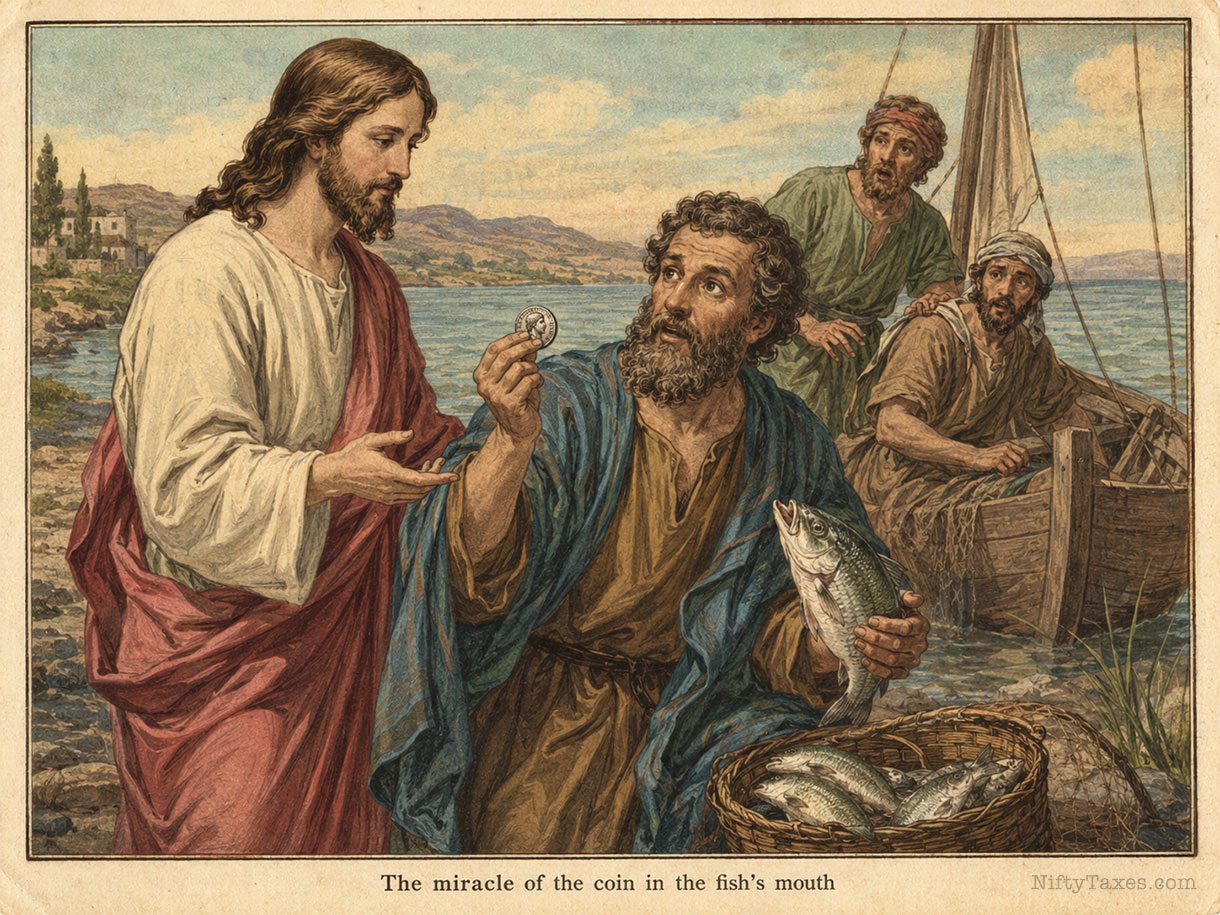
While the Caesar story is about a Roman political tax, the Gospel of Matthew 17:24-27 tells a much more personal story about a religious “Temple tax” involving Peter and a miraculous fish.
The story starts in the city of Capernaum, when tax collectors approached Peter and asked, “Doesn’t your teacher pay the Temple tax?“
FYI: The “Temple tax” was an annual two-drachma tax (described in Exodus 30:13-16) required of Jewish men age 20+ by the law of Moses to support the Temple in Jerusalem.
Peter answers yes.
Later, Jesus raises an interesting question, asking Peter whether earthly kings collect duties and taxes from their own children, or from others?”
Peter replied that they collect them from others, and a fascinating conversation ensued between the two men. Jesus argued that “the children are exempt,” and as the Son of God, he shouldn’t technically have to pay a tax to support his Father’s house, much like how the children of kings are usually exempt from taxes.
Nevertheless, Jesus tells Peter that they should pay it to avoid causing unnecessary offense, and hatched the ultimate Biblical tax-hack.
Jesus instructed Peter to go fishing, take the first fish he catches, and open its mouth.
Peter obeyed, and after catching a fish, he looked inside its mouth and found a four-drachma coin; exactly enough to pay the Temple tax for both Jesus and Peter.
Thought: I think it would have been even colder if the four-drachma coin said “In Dad We Trust“ on the back! Or, maybe Jesus and Peter could have cooked the fish and eaten it with a Caesar salad!?
The Biblical story is commonly called the miracle of the coin in the fish’s mouth. It may also contain a bit of irony, as Peter used to be a fisherman. So, Jesus sends him “back to work”, but instead of selling the fish, he finds their tax payment waiting inside of it.
Why Jesus Paying Taxes Still Matters
Why do these stories still pop up in history and pop culture? Because they show Jesus navigating a high-pressure, extractive political system with total cool.
- He was a good neighbor: He paid the Temple tax simply to avoid unnecessary conflict and to “sanctify the human bonds he wore”.
- He didn’t hate the tax man: Even though tax collectors were the most disliked people in society back then (often because they were corrupt or worked for the enemy)
Jesus set a good example and never evaded taxes, regardless of his opinion about them.
Fun Bible tax facts: Jesus’ disciple Matthew, was actually a tax collector. Another collector, named Zacchaeus, met with Jesus and was so moved that he promised to repay anyone he had cheated.
So, Did Jesus Pay Taxes?
According to the Bible, yes. Jesus arranged for the Temple tax to be paid, and although there is no specific account of him paying the Roman imperial tax, he taught his followers that civil obligations to the government should be honored.
Apparently even Jesus did not avoid death and taxes.
However, in the Bible Jesus never supported taxation as being fair or just. Instead, he reminded us that while the government might have a claim on your money, it doesn’t have the ultimate claim on your heart and soul. That’s a lesson that is still just as relevant and radical today as it was 2,000 years ago.
Jesus Tax FAQs
Yes. Matthew 17:24–27 describes Jesus providing money to pay the Temple tax for himself and Peter. The payment came from a coin found in the mouth of a fish.
Jesus paid the Jewish Temple tax, a religious contribution used to support the Temple in Jerusalem. It was different from the Roman imperial tax paid to Caesar.
Jesus said, “Give back to Caesar what is Caesar’s and to God what is God’s.” The statement appears in Matthew 22:21 and in similar passages in Mark and Luke.
Jesus told Peter to catch a fish and look inside its mouth, where he would find a coin worth enough to pay the Temple tax for both of them. The story is traditionally understood as a miracle.
Jesus recognized the duty to pay taxes to Caesar while emphasizing that our highest obligation is to God.
Related: The Rosetta Stone Was Mostly About Taxes
Do you have thoughts on Jesus paying taxes? If so, drop us a comment below, and thanks for visiting Nifty Taxes!