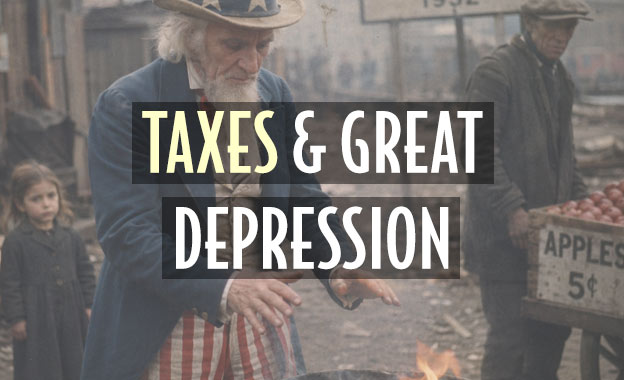
The story of the Great Depression is often told through stock market crashes, breadlines, and dust storms in the Mid-West. But beneath it all was a quieter force shaping the economy: tax policy. From the roaring prosperity of the 1920s to the experimental reforms of the 1930s, taxes played a surprisingly important role in both deepening the crisis, and helping pull the United States out of it.
The Roaring Twenties: Tax Cuts and Expansion
The 1920s, often called the Roaring Twenties, were defined by rapid economic growth, rising stock prices, and a wave of tax cuts under Treasury Secretary Andrew Mellon during the administrations of Warren G. Harding and Calvin Coolidge.
Mellon championed a philosophy that lowering taxes, especially on high earners and corporations, would spur investment and economic growth. The top marginal income tax rate dropped dramatically from over 70% after World War I to around 25% by the late 1920s. These cuts were formalized through a series of laws, including the Revenue Acts of 1921, 1924, and 1926.
In the short term, the strategy appeared to work. Businesses expanded, the stock market boomed, and federal revenues remained relatively stable due to increased economic activity. But there was a downside: wealth inequality widened, and much of the economic growth was fueled by speculation rather than sustainable production.
By the end of the decade, the U.S. economy was highly leveraged, with loose credit and fragile financial systems. Tax policy didn’t cause the Great Depression, but it helped create the conditions where risk-taking and inequality could spiral unchecked.
The Crash and Early Depression: Tax Increases Amid Crisis

When the stock market crashed in 1929 under Herbert Hoover, the government faced collapsing revenues and rising deficits. Hoover initially resisted raising taxes, fearing it would worsen the downturn. But by 1932, the situation had become dire.
The result was one of the most controversial tax laws in U.S. history: the Revenue Act of 1932.
This act sharply increased taxes across the board:
- The top income tax rate jumped from 25% to 63%
- Corporate taxes increased
- New excise taxes were introduced on everyday goods
The goal was to balance the federal budget. Instead, it had a contractionary effect. At a time when consumers and businesses were already struggling, higher taxes reduced spending power even further.
Many economists argue this tax hike deepened the Great Depression by pulling money out of an already collapsing economy. It’s a classic example of how tax policy, even when well-intentioned, can amplify economic downturns.
The New Deal Era: Taxes as a Tool for Recovery
When Franklin D. Roosevelt took office in 1933, he approached taxes very differently. Rather than focusing solely on balancing the budget, Roosevelt saw tax policy as a tool to reshape the economy and fund recovery programs.
The New Deal introduced sweeping reforms, including:
- The Revenue Act of 1934, which raised taxes on corporations and high incomes
- The Revenue Act of 1935, often called the “Wealth Tax,” targeting the richest Americans
- The Social Security Act of 1935, which created payroll taxes to fund retirement benefits
Roosevelt’s tax strategy had two goals: generate revenue for public works programs and reduce income inequality. Unlike Hoover’s 1932 increases, these taxes were more targeted at the top of the income spectrum.
At the same time, government spending surged through programs like the Works Progress Administration (WPA) and Civilian Conservation Corps (CCC). Taxes alone didn’t end the Great Depression, but they helped fund the federal response that stabilized the economy.
After the Depression: A New Tax Consensus
By the late 1930s and into World War II, the U.S. had entered a new era of taxation. The federal government took on a much larger role in managing the economy, and taxes became a central part of that system.
Top marginal tax rates climbed even higher during the war, eventually exceeding 90%. The tax base also broadened, with more Americans paying income taxes than ever before.
This shift marked a long-term change. The low-tax philosophy of the 1920s gave way to a belief that taxes could be used to:
- Fund large-scale government programs
- Stabilize economic cycles
- Reduce inequality
In many ways, the tax policies shaped during and after the Great Depression laid the foundation for the modern American fiscal system.
Did Taxes Cause or Cure the Great Depression?
The answer is complicated. Tax cuts in the 1920s contributed to economic imbalances and speculation. The sharp tax increases of 1932 likely worsened the deflationary downturn. But targeted taxation in the New Deal era helped fund recovery efforts and reshape the economy.
Taxes didn’t act alone, but they were a powerful lever. Used poorly, they deepened the crisis. Used strategically, taxes later helped support economic recovery.
FAQs About Taxes & The Great Depression
Tax cuts in the 1920s did not directly cause the Great Depression, but they contributed to rising inequality and speculative investing, which helped inflate the stock market bubble that burst in 1929.
Taxes were raised in 1932 under Herbert Hoover to offset falling government revenue and balance the federal budget during the economic collapse.
FDR used taxes to fund New Deal programs and targeted higher-income individuals with increased rates. His policies aimed to reduce inequality while supporting economic recovery through government spending.
The Revenue Act of 1932 is often seen as the most impactful early law due to its broad tax increases during a downturn. Later, the Revenue Act of 1935 and Social Security Act were key in shaping long-term economic policy.