
Benjamin Franklin’s famous observation that “nothing is certain except death and taxes” remains one of the most enduring quotations from the inventor, politician, writer, and founding father. While often cited during tax season, the history behind these words reveals a deeper reflection on the fragility of government and the uncertainty of the future.
In order to better understand the death and taxes quote, let’s look at Ben Franklin’s famous quote, earlier origins, and meaning of famous idiom.
Ben Franklin’s Letter to Jean-Baptiste Leroy 1789

Did you know Franklin’s death and taxes quote was originally written in French?
It’s true. The quote came from a letter Franklin wrote to his long-time friend, French scientist Jean-Baptiste Leroy, in November 1789.
At the time, Franklin was 83 years old and probably feeling his mortality, and having served as the U.S. Ambassador to France for nine years, he was fluent in French.
The letter itself was written by Franklin during a period of intense upheaval, and was reflecting on the stability of the newly established American government. France was also in the midst of the French Revolution and Franklin had not heard from Leroy in over a year. Fearing that his friend might have been killed in the violence and executions, he began the letter by poignantly asking, “Are you still living?”
He then wrote the following:
“Notre constitution nouvelle est actuellement établie, tout paraît nous promettre qu’elle sera durable; mais, dans ce monde, il n’y a rien d’assuré que la mort et les impôts“
The famous English translation of that quote is:
“Our new Constitution is now established, everything seems to promise it will be durable; but, in this world, nothing is certain except death and taxes.”
The U.S. Constitution had been drafted in 1776 and just recently put into practice by the Constitutional Convention in 1787. In his 1789 letter to Baptiste, Franklin remained worried about whether it would stand the test of time.
While he expressed great hope for the American experiment, he was a realist who understood that very little in the world is truly permanent. He used the certainty of death and taxes to illustrate that even the most well-crafted human institutions and governments are subject to change, uncertainty, and even chaos.
Ironically, while Leroy would survive for another decade, Franklin himself passed away only five months after writing the letter. Unfortunately, he wouldn’t live to see Congree pass the Death Tax a few years later.
Deep thought: “Are you still living?” is a great way to begin a letter to a friend, business partner, or adversary. If they reply, “No,” then you know they are lying and cannot be trusted!
Origin: Death & Taxes Quotes Before Franklin
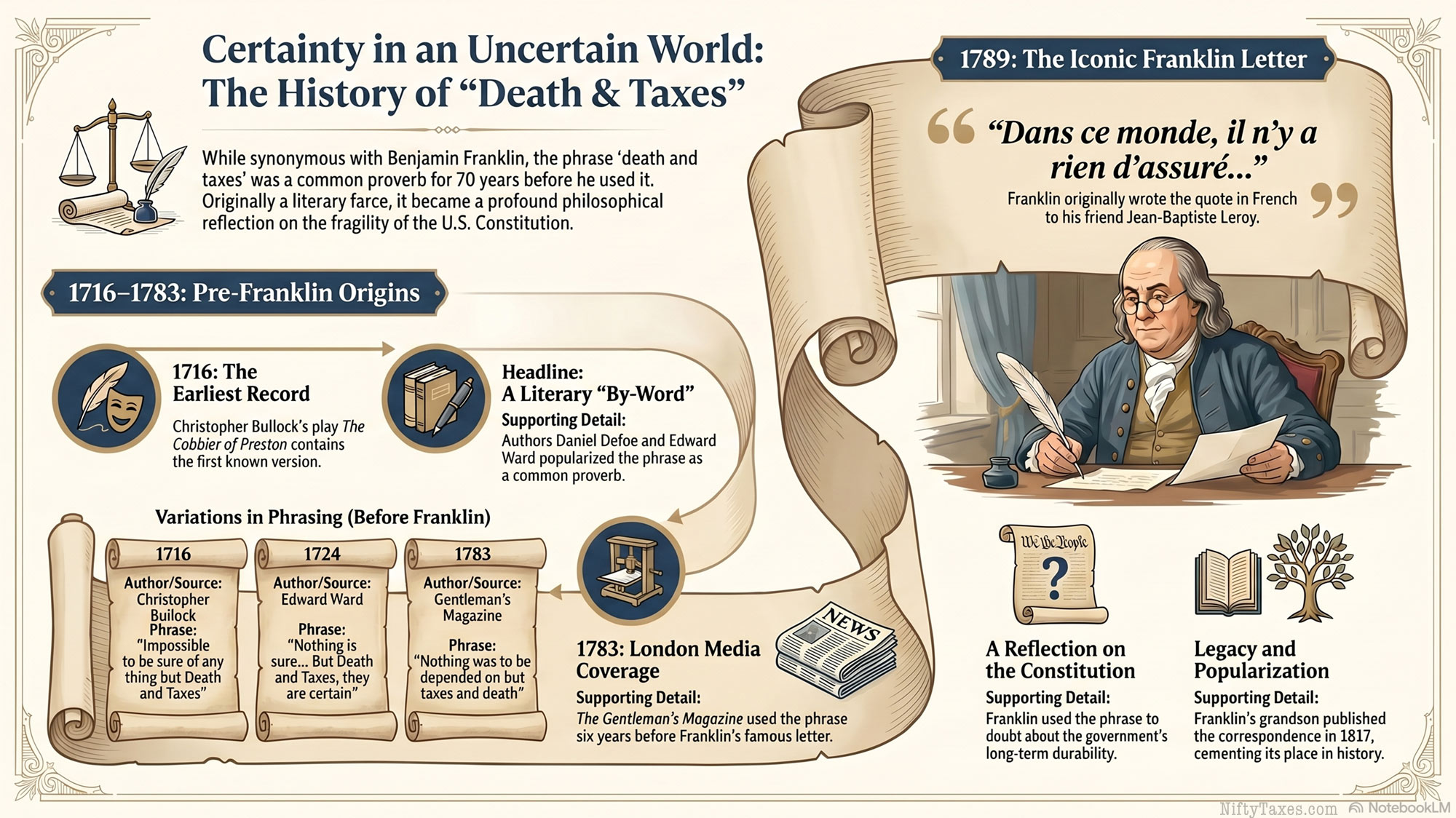
While Benjamin Franklin’s 1789 letter popularized the sentiment, the phrase “death and taxes” was circulating in literature and common speech for over 70 years before he used it.
The earliest recorded instances of “death and taxes” quotes include:
- Christopher Bullock (1716): The earliest known version appears in Bullock’s farce, The Cobbler of Preston. A character named Toby Guzzle, described as a “drunken Cobler,” remarks, “’tis impossible to be sure of any thing but Death and Taxes”
- Daniel Defoe (1717, 1726): Just a year after Bullock, the famous author of Robinson Crusoe included the phrase in his work Fair Payment No Spunge. Defoe noted that it was already a “Proverb or by-Word among us” that “there is nothing sure, but Death and Taxes”. He used it again in 1726 in The Political History of the Devil, referring to things being “as certain as Death and Taxes”
- Edward Ward (1724): In his farce The Dancing Devils, Ward wrote, “Nothing is sure i’th’ course of Fortune, But Death and Taxes, they are certain“
- Joseph Reed (1769): In the comic opera Tom Jones, a character states, “we can be sure of nothing in this world but death and taxes“
- Thomas Bridges (1770): A burlesque translation of Homer’s Iliad included the line: “Nothing stands fix’d, but death and taxes”
- The Gentleman’s Magazine (1783): Six years before Ben Franklin’s letter, this London publication featured a letter to the editor stating that “nothing was to be depended on but taxes and death”
Later writers also employed the phrase, including cat-lover Mark Twain, who employed the phrase when vowing to never change publishers again, writing that it was “just as sure as death and taxes.”
The death and taxes quote is sometimes also wrongly attributed to Shakespeare. However, The Bard did write that, “He that dies pays all debts” in The Tempest, which is pretty close!
What the Death & Taxes Quote Means Today
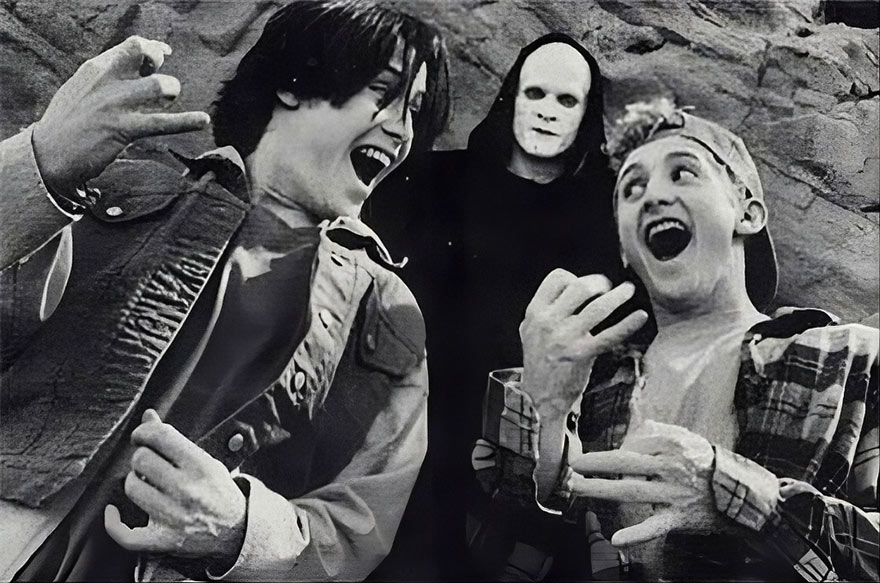
“You might be a king, or a little street sweeper, but sooner or later, you’ll dance with the Reaper” – Bill & Ted’s Bogus Journey (1991)
“Death and taxes? What an odd pairing.” – Meet Joe Black (1998)
While modern audiences often use the quote during tax season to complain about the inevitability of the IRS, its original meaning was more philosophical. The death and taxes quote served as a reminder that:
- Human Endeavors are Fragile: Even a grand achievement like the U.S. Constitution is not guaranteed to last forever. During Franklin’s time, America was still just an experiment
- Certainty is Rare: In a world where the only constant is change, very few things can be counted on with absolute confidence

So, the quote can be used when speaking of life’s few certainties, or when complaining about taxes.
Mortality, Tariffs, & Human Nature
While often attributed solely to Benjamin Franklin, the sentiment of “death and taxes” was circulating in English literature for many years before he “coined” the popular idiom.
Nevertheless, Franklin’s use of the quote to describe the fragility and uncertain future of the new U.S. Constitution gave the words a profound political and philosophical weight that resonated with the American public.
The phrase’s enduring popularity was secured in 1817 when Franklin’s grandson, William, published his private correspondence, and it was later cemented in popular culture by other famous figures like Mark Twain.
Ultimately, the death and taxes quote remains a poignant reminder that while human institutions and governments strive for durability, very little in this world can be counted on with absolute certainty.
Thanks for visiting Nifty Taxes!