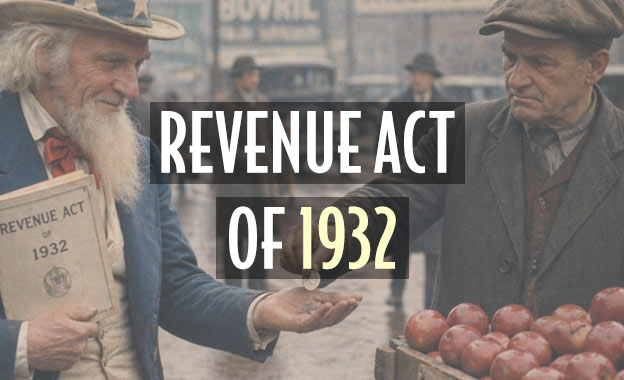
The Revenue Act of 1932 stands as one of the most controversial tax laws in American history. Passed at the depths of the Great Depression, it was designed to solve a growing fiscal crisis, but instead, many historians and economists believe it made a bad situation even worse.
To understand why, you have to step into the economic chaos of early 1930s America.
1932: A Nation in Freefall
When Herbert Hoover took office, the economy was already wobbling. By 1932, it had collapsed. Banks were failing, unemployment was soaring past 20%, and businesses were shuttering across the country.
At the same time, federal tax revenue had fallen sharply. As incomes disappeared, so did income tax payments. The government faced a growing deficit, and mounting pressure to respond.
Hoover and many policymakers at the time believed strongly in balancing the federal budget. Debt, they feared, would only deepen the crisis. That belief set the stage for the Revenue Act of 1932.
What Was the Revenue Act of 1932?
The Revenue Act of 1932 was a sweeping tax increase designed to raise federal revenue quickly. It touched nearly every part of the economy.
Here’s a summary of what it did:
- Increased the top marginal income tax rate from 25% to 63%
- Raised corporate tax rates
- Expanded excise taxes on everyday goods like gasoline, cigarettes, soft drinks, guns, jewelry, and even toiletries
- Increased the estate tax and gift taxes
Unlike later tax reforms that targeted specific groups, this law cast a wide net. It raised taxes not just on the wealthy, but also on consumers and businesses already struggling to survive.
The goal was simple: stabilize government finances. The outcome was far more complicated.
Why Raise Taxes During a Depression?

Great question! Today, raising taxes during an economic downturn may seem counterintuitive, and something you’d learn in Economics 101. However, in 1932, the dominant economic thinking was different.
Balanced budgets were seen as essential to restoring confidence. Policymakers worried that large deficits would spook investors, weaken the dollar, and prolong instability.
Hoover’s administration believed that increasing taxes was a necessary, if painful, step to restore fiscal order after the excess of Roaring Twenties. It was a decision rooted in caution, but one that collided with economic reality.
The Immediate Impact
The Revenue Act of 1932 did increase federal revenue, but only modestly. The big problem was timing.
By raising taxes during a severe economic contraction, the government effectively pulled money out of an already shrinking economy. Consumers had less to spend. Businesses had less to invest. Demand weakened further.
Economic activity slowed even more. People blamed Uncle Sam.
Many economists point to this moment as a textbook example of contractionary fiscal policy gone wrong. Instead of stabilizing the economy, the tax increases may have deepened the downturn.
Was the Revenue Act of 1932 Successful?
No, most historians believe that the Revenue Act of 1932 was a tax policy mistake.
If the goal was to balance the budget, the act fell short. Revenues rose slightly, but not enough to offset the collapse in economic activity.
If the goal was economic recovery, most evidence suggests it failed. The economy continued to deteriorate after its passage, with unemployment rising and GDP falling further into 1933.
In hindsight, the Revenue Act of 1932 is widely viewed as a policy mistake, not because raising revenue is inherently wrong, but because of when and how it was done.
Thought: Even though things ulimatedly worked out for one spunky and optimistic red-headed orphan, The Revenue Act of 1932 was a disaster for most people!
Tax Lessons That Still Matter Today
The legacy of the Revenue Act of 1932 goes far beyond its immediate effects. It helped reshape how economists and policymakers think about taxes during recessions.
One key takeaway: tax timing matters.
Raising taxes during a downturn can suppress demand and slow recovery. Later policies, particularly under Franklin D. Roosevelt, took a different approach, combining targeted taxes with large-scale government spending.
The debate continues today. When economies falter, governments still face the same question: should they raise revenue or stimulate growth?
The Revenue Act of 1932 remains a powerful case study in what can happen when fiscal caution outweighs economic urgency.
FAQs About the Revenue Act of 1932
The Revenue Act of 1932 increased income, corporate, and excise taxes to raise federal revenue during the Great Depression.
The Revenue Act of 1932 increased income, corporate, and excise taxes to raise federal revenue during the Great Depression.
No, most economists believe it worsened the Great Depression by reducing consumer spending and business investment.
The top income tax rate rose from 25% to 63%, along with increases in corporate and excise taxes.